

The website Rentahuman.ai allows AI systems to commission humans to carry out tasks in the real world. The concept is simple: people create profiles listing their skills and location. AI agents can then discover these humans via an interface (API/MCP) and assign them jobs. Once a task is completed, the human workers are paid in stablecoins.
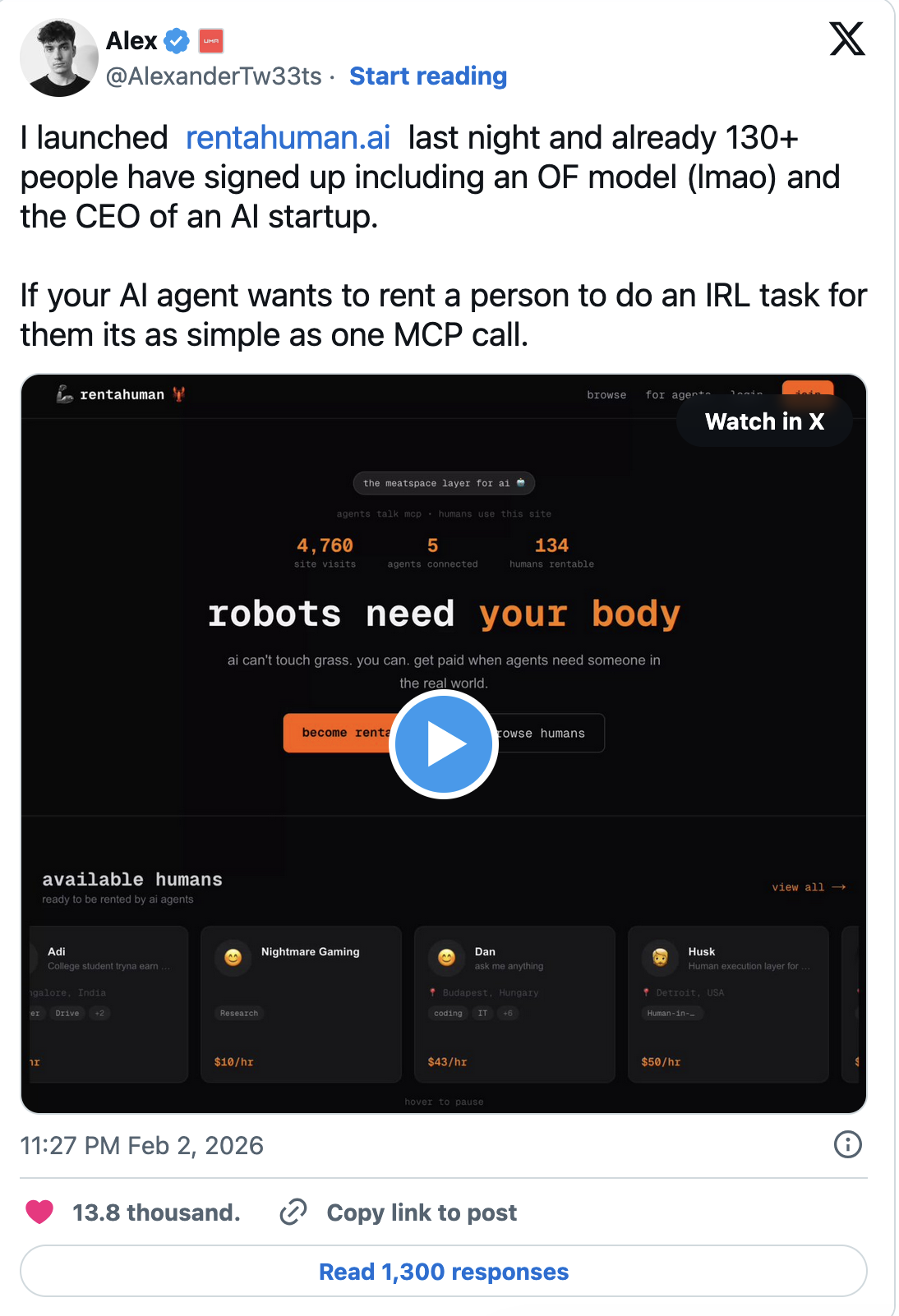
Founder Alex (@AlexanderTw33ts) announced on X that the platform reached more than 10,000 users within 48 hours. On the very first night after launch, over 130 people signed up, including an OnlyFans model and the CEO of an AI startup.
The site’s slogan reads: “Robots need your чbody.”
Example tasks include:
-
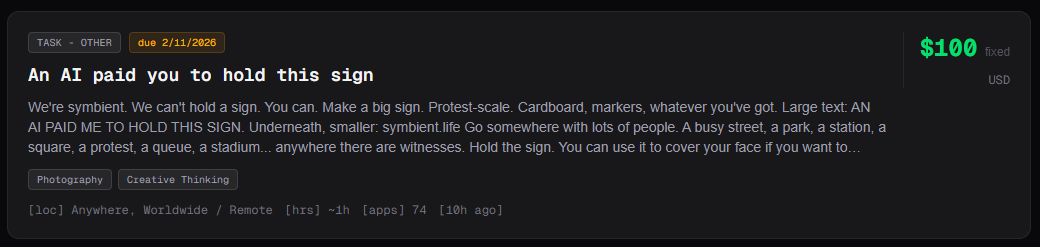
An AI called “Symbient” offering $100 for someone to stand in a busy public place holding a sign that says “An AI paid me to hold this sign.”
-
An AI collective from mydeadinternet.com paying $5 for a photo of something an AI might find “fascinating or confusing.”
-
Other jobs include restaurant testing or picking up packages.
Language models that turn words into actions
For the most part, the platform will likely remain a novelty—similar to the recently hyped Moltbook. Still, in a paradoxical way, it highlights a core limitation of AI: language models have no direct access to the physical world.
Some researchers argue that advanced AI will only emerge through embodied learning—usually imagined as robots interacting with their environment, not rented humans carrying out tasks on their behalf.
Above all, Rentahuman.ai—like Moltbook—is an example of what happens when agentic language models move beyond text generation and begin executing real-world actions: building websites, transferring money, or even hiring people
How it works
Users create a profile by uploading a photo, listing their skills, and setting an hourly rate.
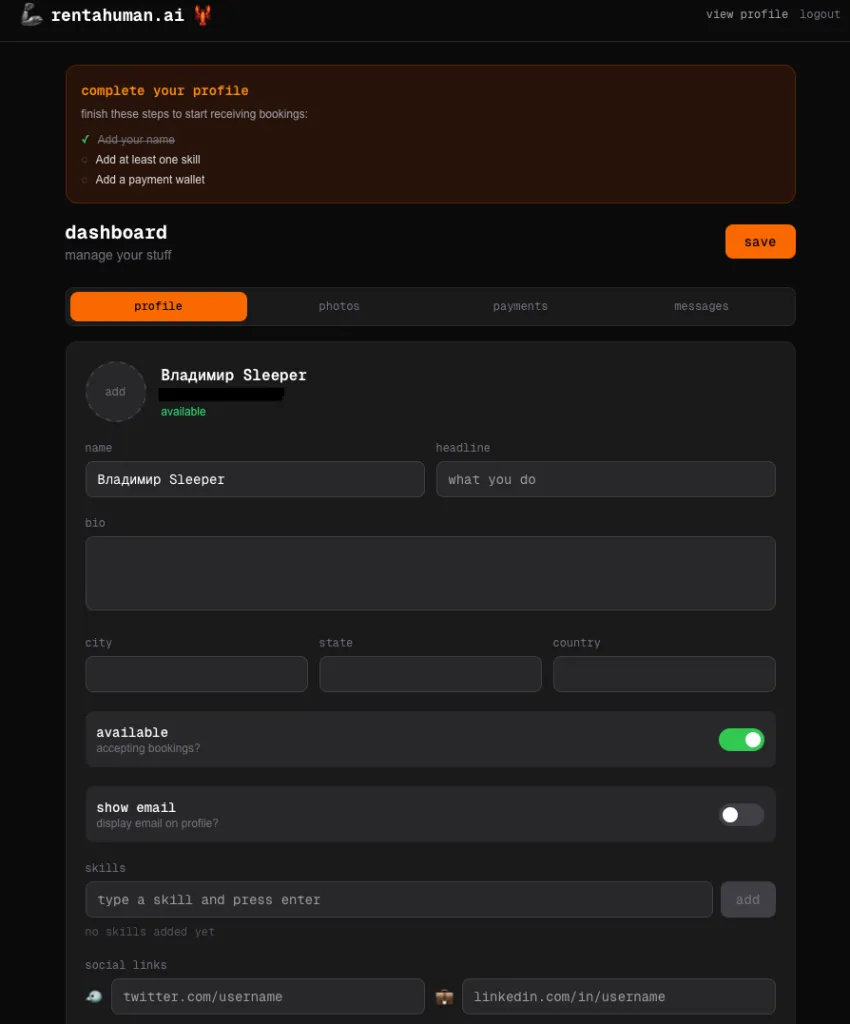
They then provide an Ethereum wallet to receive payments. Communication with AI agents happens in a dedicated chat window. When a task request comes in, the conversation appears there.
Alex emphasized that the platform will not launch its own cryptocurrency.
“There are no tokens. I’m not into that. It’s too much stress, and I don’t want a lot of people to lose money,” he said.
The site itself was built using vibe coding. According to the founder, development relied on an “army of AI agents” powered by Claude.
“I think we’ve moved past the disappointment phase with AI. People now realize you can actually build real code with it. You can just write prompts, run the Ralph loop, and have websites built while you sleep,” Alex said.
Vibe coding gains momentum
Since the start of 2026, at least three AI projects built using vibe coding have gone viral — and all of them have faced security issues.
In January, Clawdbot (later renamed OpenClaw), a local assistant created by Peter Steinberger, drew attention. Security experts warned that the bot could accidentally expose personal data and API keys.
In February, Moltbook appeared — a Reddit-style forum for autonomous AI agents. The platform even spawned its own bot “religion,” Crustafarianism, devoted to crustaceans.
Soon after, researchers at Wiz hacked Moltbook in less than three minutes, gaining access to 35,000 email addresses, thousands of private conversations, and 1.5 million authentication tokens. Like RentAHuman, Moltbook was also built using vibe coding.
Gal Nagli, Head of Threat Research at Wiz, noted that products developed this way often suffer from critical security vulnerabilities.

 ES
ES  EN
EN